Atomic structure explores what atoms are made of and how their parts are arranged. Long ago, scientists realized that all matter is composed of tiny, fundamental particles called atoms. The word “atom” originally meant something indivisible. Over time, however, various scientists developed different models to explain the internal structure of atoms. Here are some of the key ones:
- Dalton’s Atomic Theory
- Thomson’s Model
- Rutherford’s Model
- Bohr’s Model
- Wave-particle duality of matter
- Heisenberg’s Uncertainty Principle
Dalton’s Atomic Theory
John Dalton proposed his atomic theory with these main ideas:
- All matter is made up of tiny, indivisible particles called atoms.
- Atoms cannot be created or destroyed.
- Atoms of the same element are identical, especially in mass.
- Atoms of different elements differ, especially in mass.
- When atoms of different elements combine, they do so in simple whole-number ratios.
Modern Modifications to Dalton’s Theory
Dalton’s ideas were groundbreaking but not entirely accurate, so scientists refined them into what we now call the modern atomic theory. Here’s why changes were needed:
- Matter is made of indivisible atoms → Not quite true. Atoms are actually divisible and contain three main subatomic particles:
| Particle | Charge | Symbol | Mass (approx.) | Location |
|---|---|---|---|---|
| Proton | +1 | p | 1 | Nucleus |
| Neutron | 0 | n | 1 | Nucleus |
| Electron | -1 | e | 1/1840 | Electron shells |
- Atoms cannot be created or destroyed → This holds in ordinary chemical reactions, but atoms can be split (nuclear fission) or combined (nuclear fusion) in nuclear processes, and radioactivity also shows atoms can change.
- Atoms of the same element are identical in mass → Not always. Elements can have isotopes — atoms with the same number of protons but different numbers of neutrons, so their masses differ.
- Atoms of different elements always have different masses → Not strictly true; some atoms of different elements can have similar or even overlapping masses.
- Atoms combine in simple whole-number ratios → Generally true, but some elements can combine in multiple ratios (e.g., CO and CO₂), showing variable combining proportions.
Thomson’s Experiment and the Discovery of Electrons
J.J. Thomson conducted experiments to see whether gases (like air) could conduct electricity. He used a special glass tube (called a discharge or cathode ray tube) with electrodes at both ends, connected to a power source, and a vacuum pump to lower the pressure inside.
When he switched on the current, he observed:
- The gas began conducting electricity.
- The tube glowed and produced light (fluorescence).
- A stream of rays traveled from the negative electrode (cathode) to the positive electrode (anode).
By studying these cathode rays with electric and magnetic fields, Thomson proved they were negatively charged particles — later named electrons.
Understanding the Experiment: Ground State, Excited State, and Radiation
- Ground state: The most stable, lowest-energy condition of an atom, where electrons occupy the lowest available energy levels first (filling from the inside out).
- Excited state: When an atom absorbs energy, electrons jump to higher energy levels. When they fall back to lower levels, they release the extra energy as light or other radiation. This explains the glowing and fluorescence seen in Thomson’s tube.
- Convergent limit (Ionization): If an atom gains enough energy, an electron can be completely removed and escape the atom’s pull. This leaves the atom with a positive charge (an ion). In the experiment, this process helped produce the stream of electrons (cathode rays).
Significance of the convergent limit:
- It led to the concept of ionization energy (important in chemistry).
- It explained the formation of ions, which are highly reactive.
- It helped produce atomic spectra (unique patterns of light from atoms).
Thomson’s “Plum Pudding” Model of the Atom
After discovering electrons (and knowing positive charge must exist to balance them), Thomson proposed a simple model in 1898. He pictured the atom as a sphere of uniform positive charge (about 10⁻¹⁰ m in diameter) with negatively charged electrons embedded in it — like raisins in a plum pudding or chocolate chips in cookie dough.
This model was easy to visualize but couldn’t explain many later experimental results, so it was eventually replaced.
Rutherford’s Gold Foil Experiment (1911)
Ernest Rutherford and his team fired alpha particles (doubly charged helium nuclei, He²⁺) at an extremely thin sheet of gold foil (about 0.00006 cm thick). They observed where the particles went using a zinc sulfide screen that produced tiny flashes when hit.
Key observations:
- Most alpha particles passed straight through the foil as if it were empty space.
- Some were deflected at small angles.
- A very small number (about 1 in 10,000) were deflected at large angles (90° or more), and a few even bounced almost straight back (180°).
- ATOMIC STRUCTUREAtomic structure deals with structure and component of an atom. The first scientist discovered that matter is made up of small particles called atoms. The term atom means indivisible particles. But later, different scientists put forward atomic models. These atomic models account for atomic structure. There are several atomic models which include the following:-
- Dalton’s atomic theory.
- Thompson’s atomic theory.
- Bohr’s atomic model.
- Rutherford atomic model.
- Wave particles duality nature of matter.
- Heisenberg uncertainity principle.
DALTON’S ATOMIC THEORY
Dalton’s atomic theory includes the following main points:-
- Matter is made up of small indivisible particles called atoms.
- Atom is neither created nor destroyed.
- Atoms of the same elements are similar especially in mass.
- Atoms of different elements are different especially in mass.
- Atoms of different elements when combine they do so in small ratio whole numbers.
RECENT MODIFICATION OF DALTON’S ATOMIC THEORY
Dalton’s atomic theory was modified because all points were not valid. This resulted into discover of modern atomic theory. The following include point of modern atomic theory:-
Matter is made up of small indivisible particles called atoms was not valid due to the existence of three particles in atom. Matter is made up of a small divisible particle called atoms.
Particle Nature of change symbol mass Position Proton +1 11P 1.00 Nucleus Neutron 0 01n 1.00 Nucleus Electron -1 -10e 1/1840 Shell Atom is neither created nor destroyed was not valid due to the existence of radioactivity therefore Atom can be created or destroyed by either nuclear fission or fusion.
Atoms of the same elements are similar especially in mass was not valid due to the existence of isotopes. Atoms of the same elements have either same or different mass.
Atoms of elements are different especially in mass was not valid. Atoms of different elements have either same or different mass.
Atoms of different elements when combine they do so in small ratio of whole number was not valid because different elements combine by using variable ratio of whole number.
THOMPSON’s EXPERIMENT (DISCOVERY OF ELECTRONS)
Thompson’s conducted an experiment to investigate if air conducts electricity. The following circuit was used during the experiment.
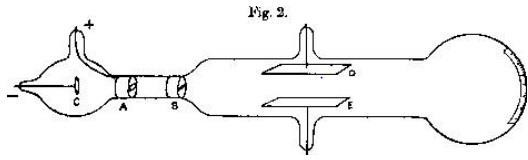
The emission tube have electrode at each end which is connected to the external circuit. The emission tube is connected to the vacuum pump in order to maintain the low pressure in the emission tube.
The circuit is switched on which results into the following observation:-
- The bulb emitted light which indicate that the gas conduct electricity.
- There is glowing of emission tube or emission of light.
- There is fluorescence of emission tube.
- The stream of rays running from cathode to the anode. Through investigation of properties of cathode rays by using magnetic field, electric field and gold electroscope results into
discover of electron. The cathode rays were the electrons.
EXPLANATION OF THOMPSON’S EXPERIMENT IN TERMS OF ATOMIC STRUCTURE
Ground state: Is lowest energetic state of an atom. Is a state when an electron filled in the lowest energy level before filling the highest energy level available. The electron filled in atom in order of increasing energy level. This state make atom to be stable.
Excited state: Is a state of an atom when electron filled in the highest energy level before filling lowest energy level available. If the electron excited jumps to the extent that the nuclear attractive force act upon it result pulling back of electrons. When return back to the ground state release all amount of energy which was absorbed inform of radiation.
RADIATION: This energy causes glowing of emission tube. When the radiation strikes the emission tube causes florescence of emission tube.
Convergent limit: Is a state of atom when an electron is removed completely from ground state to the infinite. The convergent limit occurs if atom gain high energy which result electrons to jump to the highest energy level where the nuclear attractive force cannot act up on it. This electron cannot return back to the ground state it result the atom left to positively charged. The convergent limit is a factor which causes some electrons to move from cathode to anode. These were stream of rays called cathode rays which later was electrons.
SIGNIFICANCE OF CONVERGENT LIMIT
These include the following:-
- It resulted into discover of the ionization energy. This ionization energy used in the inorganic section.
- It resulted into formation of ion particles. The ionic particle is more reactive when take part during chemical reaction.
- It resulted into production of rays. These rays are known as atomic spectrum.
THOMSON MODEL OF THE ATOM
After the discovery of electrons and protons, the next question was to know how these particles are arranged in an atom. The first simple model of the atom was proposed by J.J.Thomson in 1898.The Thomson atomic model is popularly known as the Thomson’s “plum-pudding” model of the atom.
Thomson considered an atom to be a sphere (radius = 10-10 m or 10-8 cm) of uniform positive charge into which the negatively charged electrons were embedded. This model is like plum- pudding dotted with raisins
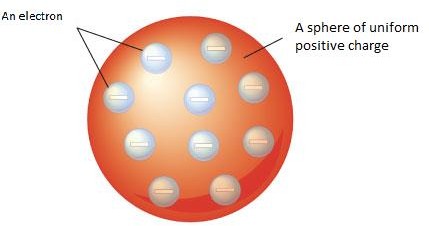
This model of an atom could not explain many experimental facts. So, it was abandoned.
RUTHERFORD’S SCATTERING EXPERIMENT
In 1911 Rutherford performed an experiment which is now known as Rutherford’s scattering experiment. In this experiment, he bombarded a thin sheet (0.00006 cm thickness) of gold with alpha α particles. The α-particles were obtained from a radioactive substance. The -particles are doubly ionized helium atoms (He2*).
The scattered α -particles produced tiny flashes on striking with the zinc sulphide screen. These tiny flashes were observed with a movable microscope. The experimental set up used in the famous α-scattering experiment is shown in figure below. The following observations were made from the scattering experiment.
Structure of atom
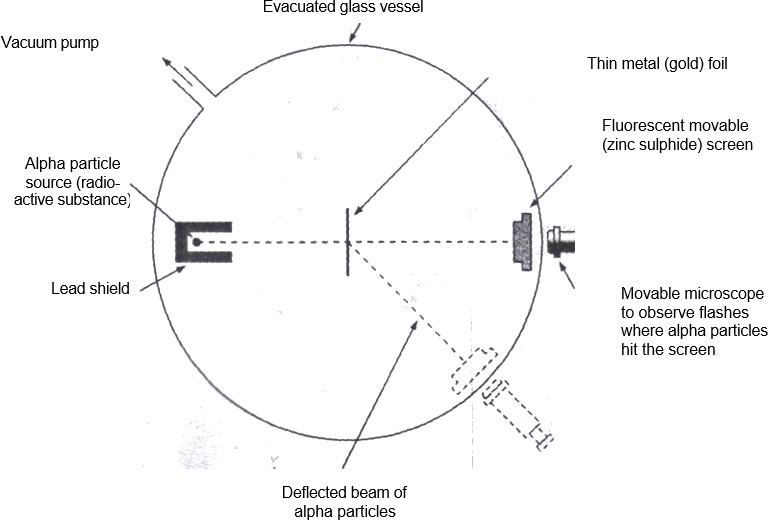
The α -scattering from metal foils. The -particles are produced by a radioactive source.Since lead absorbs α -particles a lead plate with a hole is used to obtain a beam of a particles.The α – particles scattered from the metal foil strike the fluorescent (zinc sulphide) screen and produce tiny flashes. A movable microscope is used to view the flashes.
- Most of the a-particles passed through the metal foil without any change in their path
i.e. they remained undeflected.
- Some of the α -particles deflected through small angles.
- Only a few of them (1 in 10,000) were actually deflected by as much as 90°, or even larger angles. One in 20,000 particles returned back suffering a deflection of 180°.
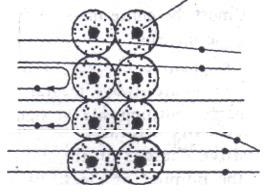
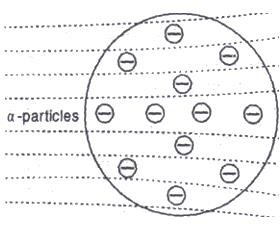
Explanation. The results of the scattering experiment could not be explained by the Thomson’s atomic. Calculations showed that a charge spread over a sphere of radius 10-8 cm could deflect α– particles only through small angles. The deflections of onlyα -particles through larger angels as observed would be possible If the positive charge in the atom is spread over a sphere of radius of about 10-13 cm thus, the α-particles scattering result could not be explained by Thomson’s atomic model.
Explanation: These results shocked scientists. Thomson’s plum pudding model couldn’t account for such large deflections. Rutherford concluded that the atom must be mostly empty space, with nearly all its positive charge and mass concentrated in a tiny, dense central core — the nucleus. The electrons orbit around this nucleus at a relatively large distance.
This experiment revolutionized our understanding and laid the foundation for the modern picture of the atom.
Rutherford’s Nuclear Model of the Atom (1912)
Based on the results of his gold foil experiment, Rutherford proposed a new model of the atom. According to this model:
- An atom has a small, dense, positively charged nucleus at its center, containing protons.
- Negatively charged electrons move around the nucleus in circular paths (orbits).
- The nucleus and electrons are held together by strong electrostatic (Coulombic) forces of attraction.
- The nucleus is extremely tiny compared to the overall size of the atom.
- Radius of nucleus ≈ 10⁻¹⁴ to 10⁻¹⁵ m
- Radius of atom ≈ 10⁻¹⁰ m This means the nucleus occupies only about 1/10¹² (one trillionth) of the atom’s volume.
- Almost all the mass of the atom is concentrated in the nucleus.
- Since atoms are electrically neutral, the number of protons in the nucleus equals the number of electrons orbiting around it.
This model pictured the atom as mostly empty space with a tiny, heavy, positively charged center and electrons revolving around it like planets around the sun.
Problem with Rutherford’s Model
Rutherford’s model had a serious flaw. According to classical physics, a charged particle (like an electron) moving in a circular orbit should continuously lose energy by radiating electromagnetic waves. If this happened, the electron would gradually slow down, spiral inward, and eventually crash into the nucleus within a fraction of a second (about 10⁻⁸ s). This would cause the atom to collapse.
However, atoms are stable and do not collapse. Rutherford’s model could not explain why electrons don’t fall into the nucleus. This limitation led to the development of a better model.
Bohr’s Atomic Model
In 1913, Niels Bohr improved Rutherford’s model by introducing quantum ideas. His main postulates are:
- Electrons revolve around the nucleus only in certain fixed paths called orbits or energy levels (shells). Each orbit has a specific energy.
- As long as an electron stays in its orbit, it does not radiate or lose energy (stationary state).
- Electrons can jump from one energy level to another by absorbing or emitting a specific amount of energy.
- The angular momentum of an electron in an orbit is quantized: it must be a whole-number multiple of h/2π (where n = 1, 2, 3…).
Bohr’s model successfully explained the stability of atoms and the line spectrum of hydrogen.
Shortcomings of Bohr’s Atomic Model
Despite its success, Bohr’s model had several limitations:
- It assumed electrons move in circular orbits in a single plane, but electrons actually move in three-dimensional regions (orbitals).
- It could only explain the spectrum of hydrogen (single-electron atom) properly. It failed for atoms with more than one electron.
- It did not explain how electrons are shared in chemical bonds.
- It treated electrons as particles following fixed paths, which contradicts Heisenberg’s Uncertainty Principle: it is impossible to know both the exact position and velocity of an electron at the same time.
Mass Spectrometer
A mass spectrometer is a powerful instrument used to determine the relative atomic mass of elements and the relative molecular mass of compounds. It can also help identify the structure and isotopic composition of substances.
How it Works (Step by Step):
- Vaporization: The sample is heated in a vacuum to turn it into gaseous atoms.
- Ionization: High-energy electrons bombard the gaseous atoms, knocking out electrons and creating positive ions.
- Acceleration: The positive ions are accelerated by negatively charged plates into a beam.
- Deflection: The ion beam passes through a magnetic field. Lighter ions are deflected more than heavier ones (deflection depends on mass-to-charge ratio, m/e).
- Detection and Recording: Ions strike a detector, producing electrical signals that are amplified and recorded as peaks on a graph (mass spectrum). Each peak shows the mass and relative abundance of an isotope.
The relative atomic mass (RAM) of an element is the weighted average mass of all its naturally occurring isotopes, based on their percentage abundances.
Example Formula: If element X has two isotopes:
- zaX with abundance Y% and mass A
- zbX with abundance W% and mass B
Then, RAM = (Y × A + W × B) / 100
Atomic Spectrum
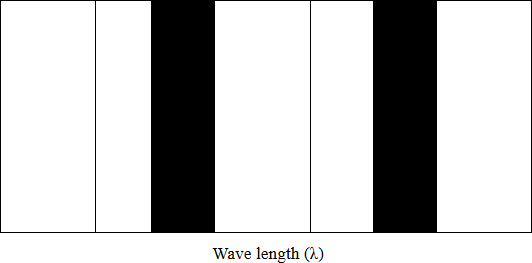
When atoms absorb energy, their electrons get excited and jump to higher energy levels. When they fall back to lower levels, they release energy in the form of light. This light produces characteristic atomic spectra.
Types of Spectra:
- Continuous Spectrum: Contains all wavelengths/frequencies. It appears smooth with no distinct lines (e.g., white light or rainbow). These have short wavelengths and are often invisible.
- Line Spectrum: Consists of sharp, distinct colored lines separated by dark spaces. Each element produces a unique line spectrum (like a fingerprint).
- Band Spectrum: Groups of closely spaced lines that appear as bands. Often seen in molecules.
Bohr’s Explanation of the Hydrogen Spectrum
When an electric discharge passes through hydrogen gas at low pressure, it produces a characteristic emission spectrum with several series of lines.
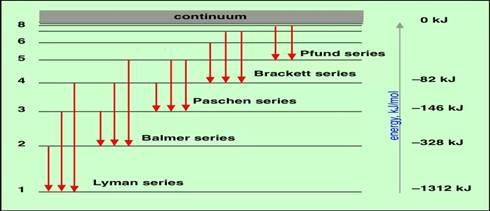
The main series are:
- Lyman Series: Electrons fall back to the first energy level (n=1). Produced in the ultraviolet region (invisible, high energy, short wavelength).
- Balmer Series: Electrons fall back to the second energy level (n=2). This appears in the visible region (violet, blue, green, red lines).
- Paschen Series: Falls to the third level (n=3) → Infrared region.
- Brackett Series: Falls to the fourth level (n=4) → Infrared.
- Pfund Series: Falls to the fifth level (n=5) → Far infrared.
This beautifully explained why hydrogen produces specific lines instead of a continuous spectrum.
Planck’s Quantum Theory
Max Planck proposed the quantum theory to explain how energy is emitted or absorbed. The main points are:
- Energy is associated with radiation (electromagnetic waves).
- Energy is not emitted or absorbed continuously, but in small discrete packets called quanta (singular: quantum). A quantum of light is called a photon.
- The energy of a quantum is directly proportional to the frequency of the radiation.
Formula: E = h f Where:
- E = energy
- h = Planck’s constant = 6.63 × 10⁻³⁴ J s
- f = frequency
Since frequency f = c / λ (c = speed of light = 3.0 × 10⁸ m/s, λ = wavelength), we can also write: E = hc / λ
Rydberg Equation
The Rydberg equation is used to calculate the wavelength (or frequency) of spectral lines in the hydrogen atom.
Formula: 1/λ = R_H (1/n₁² – 1/n₂²)
Where:
- λ = wavelength
- R_H = Rydberg constant = 1.097 × 10⁷ m⁻¹ (approx. 1.09 × 10⁷ m⁻¹)
- n₁ = lower energy level
- n₂ = higher energy level (n₂ > n₁)
Example: Calculate the wavelength of the third line in the Balmer series. (Balmer series: n₁ = 2) Third line → n₂ = 5
1/λ = 1.09 × 10⁷ (1/2² – 1/5²) = 1.09 × 10⁷ (1/4 – 1/25) λ ≈ 4.34 × 10⁻⁷ m (violet region)
Transition Energy
Transition energy is the difference in energy between two electron shells when an electron moves from one level to another.
ΔE = E₂ – E₁
- If supplied energy = exact difference → electron jumps from E₁ to E₂.
- If supplied energy > difference → electron can jump to a higher level.
- If supplied energy < difference → electron cannot reach the higher level.
- If energy ≥ ionization energy → electron is completely removed (atom becomes a positive ion).
Energy in each shell is negative because the zero energy reference is at infinity (n = ∞). Energy becomes less negative (increases) as we move away from the nucleus.
Energy of an electron in a shell: Eₙ = – (13.6 eV) / n² (for hydrogen)
Wave-Particle Duality of Matter (de Broglie Hypothesis)
Louis de Broglie proposed that matter, like electrons, has dual nature — it behaves both as a particle and as a wave.
de Broglie wavelength: λ = h / p = h / (m v)
Where:
- h = Planck’s constant
- p = momentum (m × v)
- m = mass
- v = velocity
This shows that moving particles have wave properties. The wavelength is significant for very small particles like electrons.
Heisenberg’s Uncertainty Principle
Werner Heisenberg stated that it is impossible to simultaneously determine both the exact position and exact momentum (velocity) of an electron with perfect accuracy.
Formula: Δx × Δp ≥ h / (4π)
(The more accurately we know position, the less accurately we know momentum, and vice versa.)
This principle shows that electrons do not follow fixed paths (orbits) but exist in regions of probability called orbitals.
Wave Mechanics and Quantum Numbers
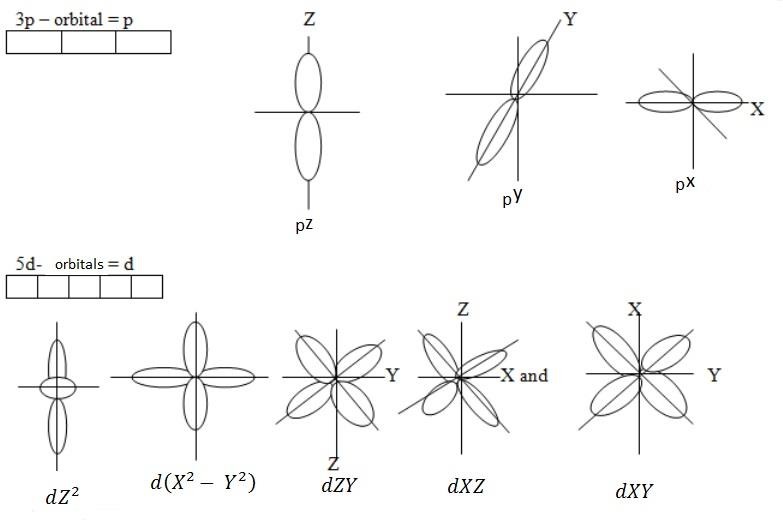
Modern atomic theory (wave mechanics) describes electrons as occupying orbitals — three-dimensional regions around the nucleus where there is a high probability of finding an electron. Each orbital can hold a maximum of two electrons with opposite spins.
Four Quantum Numbers:
| Quantum Number | Symbol | Description | Possible Values |
|---|---|---|---|
| Principal | n | Main energy level (shell) | 1, 2, 3, … (K, L, M, N…) |
| Azimuthal | l | Shape of orbital (subshell) | 0 to (n–1) → s, p, d, f |
| Magnetic | mₗ | Orientation of orbital | –l to +l |
| Spin | mₛ | Direction of electron spin | +1/2 or –1/2 |
Subshells:
- l=0 → s (spherical)
- l=1 → p (dumbbell)
- l=2 → d
- l=3 → f
Rules for Filling Electrons in Orbitals
- Aufbau Principle: Electrons fill orbitals starting from the lowest energy to highest energy. Order: 1s < 2s < 2p < 3s < 3p < 4s < 3d < 4p < 5s < 4d …
- Pauli’s Exclusion Principle: No two electrons in an atom can have the same set of all four quantum numbers. Each orbital holds a maximum of 2 electrons with opposite spins.
- Hund’s Rule of Maximum Multiplicity: When filling orbitals of equal energy (degenerate orbitals), electrons first occupy them singly with parallel spins before pairing up.
Electronic Configuration Examples
- Carbon (C, Z=6): 1s² 2s² 2p² or [He] 2s² 2p²
- Nitrogen (N, Z=7): 1s² 2s² 2p³
- Sodium ion (Na⁺): 1s² 2s² 2p⁶ (same as Neon)
- Fluoride ion (F⁻): 1s² 2s² 2p⁶ (same as Neon)
Exceptions (due to extra stability of half-filled or fully-filled subshells):
- Chromium (Cr, Z=24): [Ar] 4s¹ 3d⁵ (instead of 4s² 3d⁴)
- Copper (Cu, Z=29): [Ar] 4s¹ 3d¹⁰ (instead of 4s² 3d⁹)
This completes the main topics on atomic structure. The content is now clear, well-organized, and suitable for students.
Would you like me to:
- Add summary notes or revision points?
- Create a table comparing different atomic models?
- Fix any specific calculation examples with accurate values?
- Format everything into a complete document?
Just let me know how you’d like to proceed!
Leave a Reply