Methods of Preparing Alkanes
Here are the main ways to prepare alkanes, explained in a straightforward way:
1. Hydrogenation of Alkenes and Alkynes Alkenes and alkynes can be converted into alkanes by adding hydrogen gas in the presence of a metal catalyst like nickel (Ni) or platinum (Pt). The reaction typically needs heating (around 200–300°C). This is a clean and common method.
2. Reduction of Alkyl Halides (Haloalkanes) There are several ways to reduce alkyl halides to alkanes:
- Using zinc and acid: Zinc metal in acid displaces the halogen (e.g., bromine) with hydrogen.
- Zinc-copper couple in alcohol: Both zinc and copper must be present together with alcohol for this reduction to work.
- Hydroiodic acid with red phosphorus: Red phosphorus helps by removing iodine, allowing hydrogen to replace the halogen.
3. Wurtz Synthesis Alkyl halides react with sodium metal in dry ether. This couples two alkyl groups to form a longer-chain alkane (the product always has twice the number of carbons as the starting alkyl halide). Dry ether is essential for the reaction.
4. Decarboxylation of Sodium Carboxylate Salts Heat a sodium salt of a carboxylic acid with sodium hydroxide (NaOH) and calcium oxide (CaO, also called soda lime). The product alkane has one fewer carbon atom than the original carboxylate salt.
5. From Petroleum and Natural Gas Petroleum (crude oil) comes from the remains of ancient marine organisms buried millions of years ago. It’s a complex mixture of hydrocarbons trapped in underground reservoirs (like limestone). We extract it by drilling oil fields.
- Fractional Distillation: Crude oil is heated in a tall distillation tower. Different fractions condense at different heights based on boiling points:
- Petroleum gas
- Petrol (gasoline)
- Naphtha
- Kerosene
- Diesel
- Fuel oils
- Lubricating oils
- Residuals (asphalt, tar, coke)
Cracking Larger molecules from crude oil are broken into smaller, more useful ones:
- Thermal cracking: Heat large molecules to very high temperatures until they break apart.
- Catalytic cracking: Use a catalyst to speed up the process at lower temperatures.
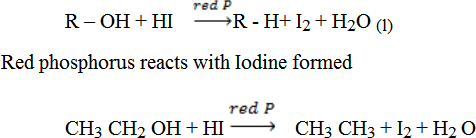
6. From Alcohols Alcohols can be reduced to alkanes by heating them with concentrated hydroiodic acid (HI) and red phosphorus at about 423 K under pressure.
Physical Properties of Alkanes
- Boiling and Melting Points: Alkanes have relatively low melting and boiling points because they are non-polar molecules held together by weak van der Waals forces.
- As molecular mass increases, boiling and melting points increase.
- Straight-chain alkanes have higher boiling/melting points than branched isomers of the same mass because straight chains have more surface area for intermolecular forces. Branched chains are more compact, so they pack less efficiently.
- Solubility: Alkanes dissolve well in non-polar solvents but are insoluble in water (polar solvent).
Chemical Properties of Alkanes
Alkanes are generally quite unreactive (inert) compared to other organic compounds because:
- They lack functional groups.
- C–C and C–H bonds are strong and non-polar, so they don’t easily attract electrophiles or nucleophiles.
They mainly react under high temperature, light, or specific catalysts. Important reactions include:
1. Substitution Reactions
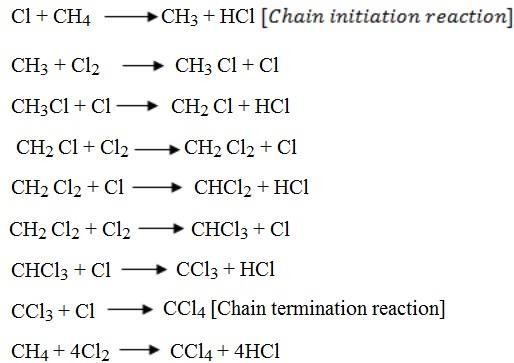
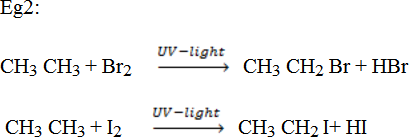
- Halogenation (Free Radical Substitution): Alkanes react with halogens (Cl₂ or Br₂) under UV light to replace hydrogen with halogen. It proceeds via free radicals (atoms or groups with unpaired electrons). UV light generates the radicals by breaking the halogen molecule. Note: Fluorine reacts violently; controlled fluorination needs special conditions.
- Nitration: Mix alkane vapor with nitric acid vapor and heat to 400–500°C. A nitro group (–NO₂) replaces one hydrogen.
- Sulphonation: Prolonged reaction with fuming sulfuric acid replaces one hydrogen with a sulfonic acid group (–SO₃H).
2. Oxidation (Combustion) Alkanes burn cleanly in excess oxygen to produce carbon dioxide and water. The reaction is highly exothermic (releases a lot of heat).
3. Thermal Decomposition (Pyrolysis/Cracking) Heating alkanes in the absence of air breaks them into smaller alkanes and alkenes.
4. Isomerization (Catalytic) Straight-chain alkanes can be converted to branched-chain isomers by heating with aluminum chloride and dry HCl at around 300°C. This doesn’t break the carbon chain but rearranges it. Branched alkanes have higher octane numbers, making them better for petrol.
Aromatization: Certain alkanes can also be converted into aromatic compounds under specific catalytic conditions (not detailed here).
Aliphatic Hydrocarbons
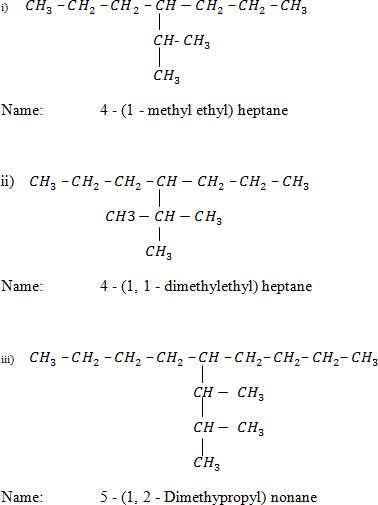
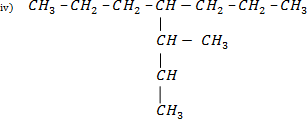
Nomenclature:
METHODS OF PREPARATION OF ALKANES
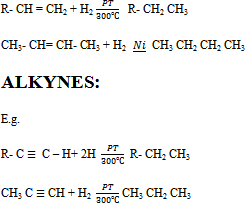
- Hydrogenation of Alkenes and Alkynes


Alkenes and alkynes react with hydrogen in presence of catalyst eg Ni/Pt around 200 c or 300 c From Alkenes
Method 2 of preparation
Alkyl halide (haloalkanes)

Reduction of alkyl halide by metal and acid

The hydrogen displaces Bromine. Only done in the presence of Zn metal
Reduction of Alkyl halide by using zinc and copper coupled with alcohol

Note:
Both zinc and copper must be present together with alcohol.

Reduction of alkyl halide by using hydroiodic acid in the presence of red phosphorus

NOTE:
Function of red phosphorus is removing iodide so that hydrogen can react with the alkyl halide.

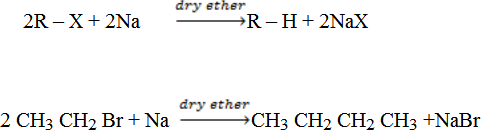
Wurtz Synthesis
Alkyl halide in dry either solution react with sodium to produce alkane always the product has twice the number of carbon as that of alkyl halide.
 ii)
ii)
NOTE:
Dry ether is very important condition.
Decarboxilation of sodium carboxilate salt
This is the reaction between carboxylic salt and sodium hydroxide in the presence of calcium oxide. The product will have 1carbon less than the reactant.

Exercise (H/W)
- Preparation of alkanes from petroleum, coal, natural gas.
- Read on method of preparation known as cracking. Preparation of alkanes from petroleum and natural gas.
- Petroleum is formed from the remains of tiny marine organisms that died and sank to the bottom of the sea millions of years ago.
- Petroleum is a mixture of many organic compounds, since the organic compounds are lighter than both the rock and the water they move upwards through the adjacent rock. Sometimes the organic Compound are trapped in porous rocks that are called reservoirs beneath impermeable rocks.
- Example of reservoir is limestone.
- Reservoirs from which petroleum can be extracted by drilling are referred to as oil fields.
- The petroleum obtained is referred to as a crude oil.
Fractional distillation of crude oil:
-
- Major components of crude oil are:-
- Residuals (coke, asphalt, tar).
- Lubricating oils.
- Fuel oils.
- Diesels.
- Kerosene.
- Naptha.
- Petrol.
- Petroleum gas.
The components of the crude oils are known as fractions and different fractions are separated by heating them in a process known as Fractional distillation and it is done in a distillation tower called a still.
The oil is first evaporated by heating . The vapour rises up and the tower acts as a giant heat exchanger
 removing heat from the gases as they rise up. Temperature falls to 20 by the time vapour reaches the top. The vapour condenses as they rise up.
The heavier ones i.e. those with higher boiling points condense first. Gaseous fractions pass out at the top.
Cracking
Some of the fractions obtained from the fractional distillation of the crude oil are converted into new products.
Cracking is the conversion of large molecules of organic compounds into compounds with smaller molecules.
There are two methods;-
- Thermal cracking.
- Catalytic cracking.
In thermal cracking the large molecule organic compound is heated to a high temperature until its molecule break apart.
In catalytic cracking, a catalyst speeds up the cracking process.
Preparation of Alkanes from alcohols:
By reduction of alcohols:
When alcohols are hated with concentrated hydroiodic acid and red phosphorus at 423k under high pressure, alcohols can be reduced to alkanes.
Physical properties of alkanes:
Boiling point and melting point:
Alkanes have low melting point and boiling point.
Reason: Since alkanes are non-polar molecules with weak Van – der – Waal forces between them then low temperature is required to break the bond hence low melting and boiling point.
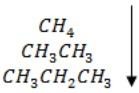 Increase in molecular mass leading to the increase in melting & Boiling points
NB:
If you compare straight chain and branched chain of same molecular mass; straight chain has higher M.P &B.P. Branched chained isomers have lower boiling points and melting point than straight chain isomer.
Reason: Branched chains are more compact hence have less surface area. This is why they have low M.P and B.P. Straight chains have higher surface area.
Solubility:
They are soluble in non polar organic solvents but insoluble in polar compounds e.g. Water.
Chemical properties of alkanes:
In general, alkanes are non reactive (inert) compared to other classes of organic compounds.
Reason:
- They don’t have a functional group.
- There bonds are quite strong i.e. c – c (strong bond). Large energy is needed to break the bond hence less reactive.
- These two bounds are almost non polar and therefore neither electrophilic nor nucleophilic substitution reaction can take place. Can’t react with electron – loving species or a proton loving species (Nucleophilic).
- Electrophilic reacts with a negatively charged species.
- Nucleophilic reacts with a positively charged species.
Alkanes can undergo the following reaction;-
-
- Substitution reaction.
- Oxidation reaction.
- Thermal decomposition (cracking).
All these reactions take place at high temperature or under the presence of light energy.
- SUBSTITUTION REACTIONS
 Halogenations
- This is addition of halogens.
- The reaction between alkane and halogen is known as free radical substitution reaction.
- Free radical substitution reaction is the reaction in which a free radical substitutes atom/atoms in a molecule.
Q. What is a free radical?
A free radical is an atom or group of atoms which consist of unpaired electrons.
 Example:
- Function of UV – light is to give out a free radical.
Mechanism of reaction

Homolytic sharing of electron i.e. equal sharing of electrons go to each chlorine atom
NOTE:
Free radicals are very reactive. It wants to become stable.
NOTE:
 With fluorine, the reaction is violet and yield hydrogen fluoride and carbon.
However, controlled fluorination in the presence of cobalt moderator the fluoral derivatives are formed.
NITRATION (With Nitric acid)


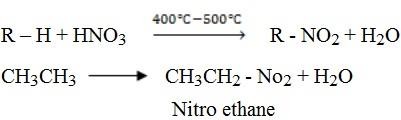 This involves the substitution of hydrogen atom in alkane with NO2 group. This is done when a mixture of alkane and nitric acid vapour is heated at 400 c – 500 c
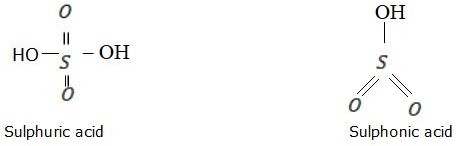
SULPHONATION (With sulphuric acid)
Alkanes when subjected to prolonged reaction with fuming sulphuric acid one hydrogen atom of alkane is replaced with – SO3 H group known as sulphonic group.

Oxidation Reactions:
When alkanes are ignited in the presence of excess oxygen they burn to form carbondioxide and water only.
 Reaction is highly exothermic:
Thermal decomposition (PYROLYSIS)
This is breaking down of higher alkane into lower alkane by heating alkanes in absence of air.

Alkane and alkene are the only possibilities.
NOTE:
No two alkenes will be formed.
Catalytic cracking (Isomerization)
 When straight chains of alkanes are heated in aluminium chloride in the presence of dry hydrogen chloride at 300 gives a branched chain isomers. In this process there is no breaking of the compound
but it is changed to branched chain.
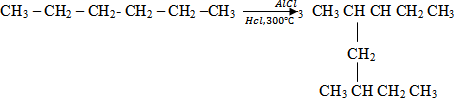
This process is used in petrol chemical industry. The branched chain alkane has higher octane number. Hence branched chain burns easily than straight chains.
Question:
- How to form aromatic compounds i.e. Aromatizations
- Uses of alkanes
Exercise:
Qn. How can the following conversions be achieved?
- Propyne to propane
- Hexane to 3methylpentane
- Ethane to butane
- Pentane to nitropentane
Solution:
Quick Conversions (Exercises)
Here’s how you can achieve these:
- Propyne to Propane → Hydrogenation with H₂ + Ni/Pt catalyst.
- Hexane to 3-Methylpentane → Isomerization using AlCl₃ + dry HCl.
- Ethane to Butane → Wurtz reaction (ethyl halide + Na in dry ether).
- Pentane to Nitropentane → Nitration with HNO₃ vapor at 400–500°C.
Aromatization Alkanes with six or more carbon atoms can be converted into aromatic compounds when heated under pressure in the presence of a suitable catalyst. This process is called aromatization or reforming.
Example: n-Hexane → Benzene
Uses of Alkanes
Alkanes are the simplest hydrocarbons (containing only carbon and hydrogen). Here are their main uses:
- Fuels: Lower alkanes (from natural gas and light petroleum fractions) are widely used as fuels (e.g., methane, propane, butane, petrol).
- Solvents: Low-boiling liquid alkanes like hexane are excellent non-polar solvents.
- Lubricants and Waxes: Heavy petroleum fractions are used to make lubricating oils, grease, paraffin wax, and petroleum jelly (vaseline).
- Detergents: Products from the cracking process are used to make linear alkyl benzene (LAB), a key raw material for manufacturing detergents.
ALKENES
Alkenes are unsaturated hydrocarbons that contain at least one carbon-carbon double bond (C=C).
- General formula: CₙH₂ₙ (same as cycloalkanes — these are called functional group isomers).
- Functional group: C=C
- Hybridization: sp² (trigonal planar geometry around the double-bonded carbons).
- First member: Ethene (C₂H₄)
Nomenclature
- The longest chain containing the double bond is chosen as the parent chain.
- The chain is numbered to give the double bond the lowest possible number.
- Examples:
- C₂H₄ → Ethene
- C₃H₆ → Propene
- 3-Methylbut-1-ene
- 3-Propylhex-2-ene
- 2,3-Dimethylhex-2-ene
- 6-Methylhepta-1,3,6-triene (for compounds with multiple double bonds)
Types of Isomerism in Alkenes
Alkenes show four main types of isomerism:
- Chain (Skeletal) Isomerism – Different carbon chain arrangements.
- Positional Isomerism – Different position of the double bond.
- Geometrical (Cis-Trans) Isomerism – Different spatial arrangement around the double bond (restricted rotation).
- Functional Isomerism – Same molecular formula but different functional groups (e.g., alkene vs cycloalkane).
Laboratory Preparation of Alkenes
1. Dehydrohalogenation of Alkyl Halides Alkyl halide (R–X) is heated with alcoholic KOH or NaOH. This is an elimination reaction (removal of HX).
Saytzeff’s Rule: The major product is the more substituted alkene (hydrogen is removed from the carbon with fewer hydrogens).
2. Dehydration of Alcohols
- Heat alcohol with concentrated H₂SO₄ at 175–180°C.
- Alternative: Pass alcohol vapour over heated alumina (Al₂O₃) at 350°C or use concentrated H₃PO₄.
3. Dehalogenation of Vicinal Dihalides Vicinal dihalides (halogens on adjacent carbons) are treated with zinc dust in alcohol.
4. Controlled Hydrogenation of Alkynes
- Partial hydrogenation using Lindlar’s catalyst (poisoned Pd/CaCO₃ + quinoline) gives cis-alkene.
- Na or Li in liquid ammonia gives trans-alkene.
Chemical Properties of Alkenes
Alkenes are more reactive than alkanes because the π-bond is weaker and easily broken. They mainly undergo electrophilic addition reactions.
1. Addition of Hydrogen Halides (HX) Follows Markovnikov’s Rule: “The hydrogen adds to the carbon that already has more hydrogens.”
Reason: It forms the more stable carbocation intermediate.
Anti-Markovnikov Addition (Peroxide Effect): Addition of HBr in the presence of organic peroxide (Kharasch effect) gives the opposite orientation.
2. Hydration (Addition of Water) Alkene + water (in presence of conc. H₂SO₄) → Alcohol (follows Markovnikov’s rule).
3. Halogenation
- Alkenes react with Br₂ or Cl₂ in CCl₄ to form vicinal dihalides.
- Test for unsaturation: Bromine water (brown) is decolourised by alkenes → positive test for C=C bond.
4. Hydrogenation Alkene + H₂ (Pt or Ni catalyst) → Alkane.
5. Oxidation Reactions
- Cold, dilute alkaline KMnO₄ (Baeyer’s reagent): Forms diol (two –OH groups).
- Hot, concentrated acidified KMnO₄ or K₂Cr₂O₇: Cleaves the double bond to form carboxylic acids, ketones, or both (depending on the structure).
- Ozonolysis (O₃ followed by Zn/H₂O): Completely breaks the C=C bond to form aldehydes and/or ketones. This is the best method to determine the position of the double bond in an unknown alkene.
Practice Question Solution:
A compound A (C₆H₁₂) is an unsaturated hydrocarbon. On ozonolysis, it gives two compounds C and D, both with formula C₃H₆O, and both are ketones. Identify A, C, and D.
Solution: Since both products are ketones with 3 carbons each, the double bond must be in the middle and symmetric.
Compound A is 2,3-dimethylbut-2-ene. Ozonolysis gives two molecules of acetone (propanone) as C and D.
Leave a Reply